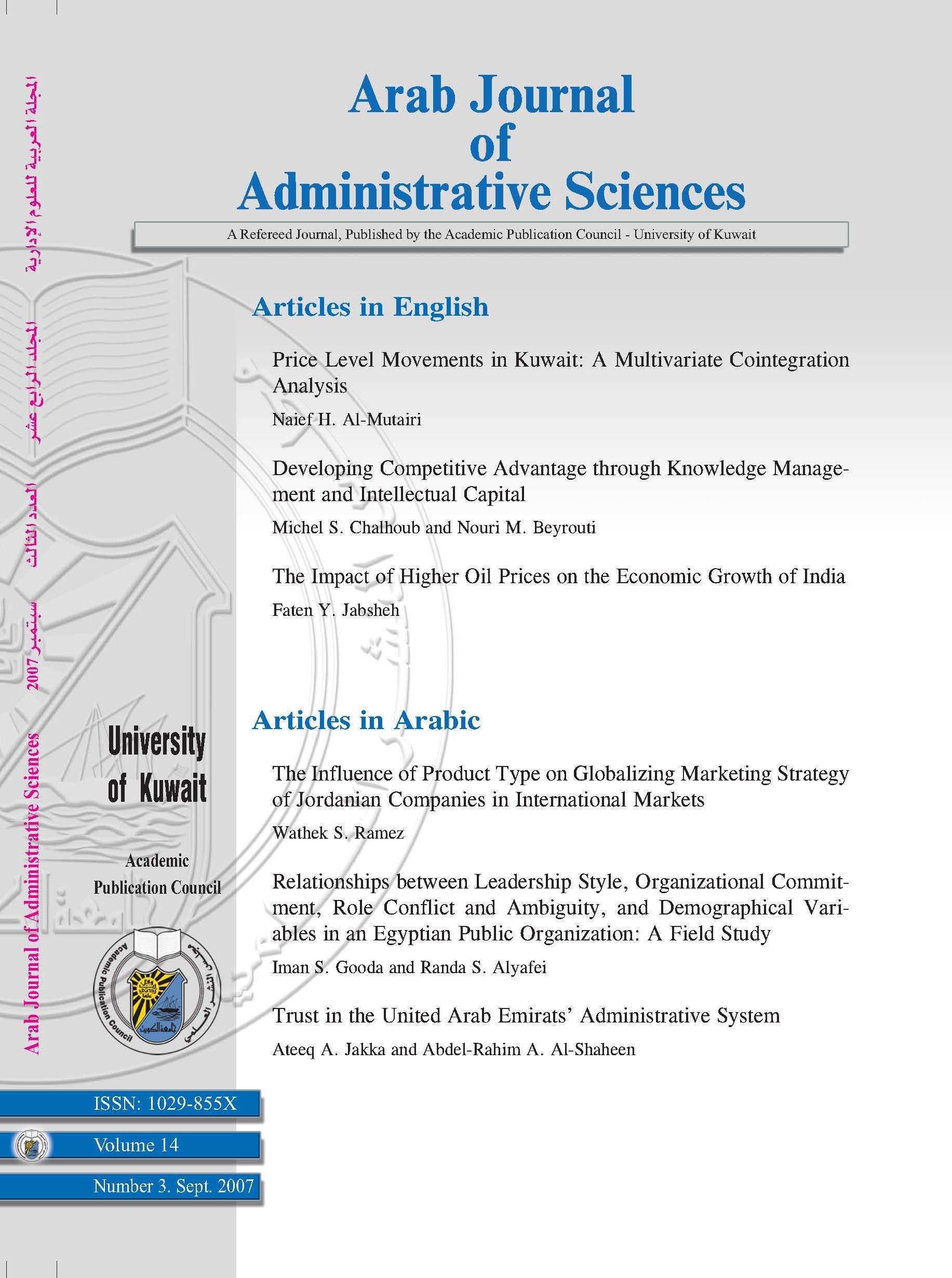
Relationships between Leadership Style, Organizational Commitment, Role Conflict and Ambiguity, and Demographical Variables in an Egyptian Public Organization: A Field Study
DOI:
https://doi.org/10.34120/ajas.v14i3.665Keywords:
Subordinate-directed behavior, Subordinate-supportive behavior, Role conflict, Role ambiguity, Organizational commitment, power centerAbstract
The purpose of this study is to investigate the relationships between four components: leadership style (according to Fiedler Theory), organizational commitment, role conflict and ambiguity, and some demographical variables in an Egyptian public organization. The questionnaires were distributed to managers working in a Development and Growth organization. The results indicated that there were relationships between a leader's style and his organizational commitment; and between a leader's style and his role conflict and ambiguity. The relationship between a leader's organizational commitment and his role conflict and ambiguity was negative. Moreover, there were significant differences between age, social status, job level on the one hand and a leader's style on the other. Similarly, there were significant differences between age and a leader's organizational commitment and between age, experience, educational level, gender, and a leader's role conflict and ambiguity. The data also showed that a high percentage of the leaders participating in this research adopted a supportive style.
Downloads